Isolation Before Isolation: Sequencing Utility Disconnections Ahead of Demolition
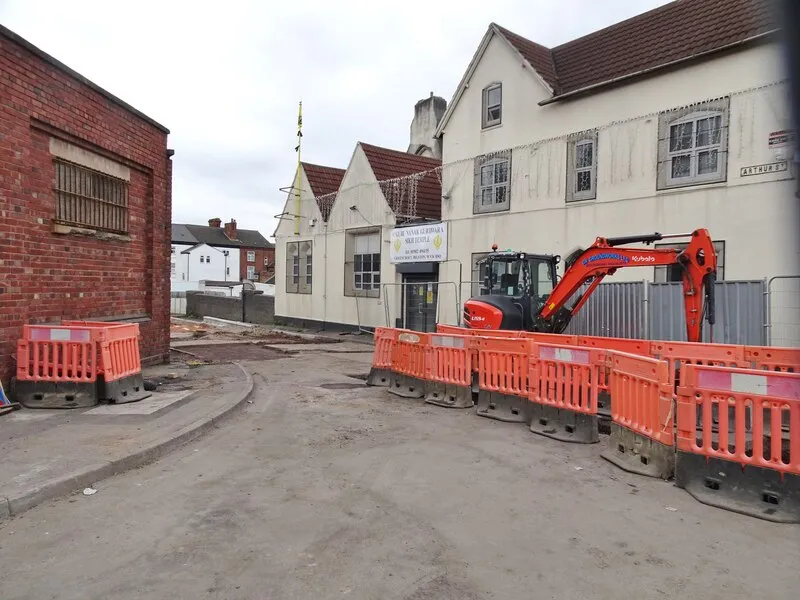
Photo: Gordon Griffiths , CC BY-SA 2.0, via Wikimedia Commons
Most demolition programmes are drafted from the end backwards: possession date, plant mobilisation, structural works, handover to the groundworks contractor. Service isolation is usually bolted on at the front as a line item of a fortnight, on the assumption that a phone call and a meter removal will cover it. On constrained urban sites that assumption is the single most common cause of a stalled start. Isolations do not fail because contractors are careless; they fail because the ownership of each asset, and the statutory process attached to it, was never mapped before the programme was fixed.
Begin With the Asset Register, Not the Phone Call
The first deliverable on any demolition project should be a services register that names, for every asset crossing or serving the site, the party legally responsible for it. In practice that means distinguishing clearly between:
- Electricity distribution. The district network operator for the area, or an independent network operator where the site sits on a privately adopted network. Large sites frequently carry their own high-voltage ring main and substation, which may be landlord-owned rather than the network operator's responsibility.
- Gas. One of the four gas transporters, depending on region.
- Water and sewerage. The regional water company, but not necessarily the same company for both, and not always the owner of private drainage, pumping stations or culverts within the curtilage.
- Telecoms. Openreach copper and fibre, alternative network providers, and internal structured cabling that belongs to nobody but the occupier.
- Unmetered apparatus. Street lighting columns, illuminated signs, traffic signals and CCTV masts, which are usually the highway authority's asset and are frequently live long after the building is empty.
The register should be built from record drawings, a site walkover with the utility plans in hand, and a physical trace where records are absent. On sites that have been extended piecemeal over several decades, records and reality diverge more often than not.
Electricity Is Usually the Long Pole
Developers routinely conflate three different things: de-energisation, disconnection and diversion. De-energisation is a switching operation. Disconnection removes the supply permanently and typically involves removing the meter and sealing the service. A diversion is a construction project in its own right, requiring design, a point of connection, often new capacity, and sometimes an easement.
Lead times follow that hierarchy. A straightforward low-voltage disconnection may be achievable in six to ten weeks once the application is accepted and any outstanding charges settled. A high-voltage diversion on a city centre site can run to several months, and the design phase alone may consume a quarter. Where the site needs a builders' supply or a temporary substation to run welfare units, pumps and tower crane, that is a new connection rather than a disconnection, and it sits in a different queue.
An early call to the network operator is not the same as an early application. Applications need a supply number, a site plan, confirmation of what remains live and, on larger sites, an earthing study. Missing paperwork resets the clock.
Gas, Water and Telecoms: Shorter Fuses, Same Traps
Gas disconnection is generally measured in weeks rather than months, but the process has its own dependencies: the transporter must attend to purge and cap the service, and the meter must be removed before the pipework can be cut and sealed inside the building. Where gas is required for temporary site heating or welfare, the sequencing reverses entirely and should be planned as such.
Water disconnection is usually the quickest of the statutory processes, but it carries a commercial sting. Final meter readings matter, and unpaid charges can follow the site rather than the former occupier unless settled at handover. On larger sites the water company may also require a fire hydrant assessment and confirmation that private storage and booster sets have been isolated properly.
Telecoms are frequently overlooked because they carry no visible risk. Cease orders typically run on 30-day cycles, and a line left live will keep accruing rental until someone takes responsibility for it. Redundant copper and fibre within risers should be stripped and removed under the soft strip scope rather than left to the demolition contractor to discover.
Drainage Is Where Programmes Actually Die
Public sewers crossing a demolition footprint cannot simply be demolished around. They require a diversion agreement with the sewerage undertaker, supported by a CCTV condition survey, a design for the replacement run, and often a construction phase agreement with an inspector on site. Where the sewer is to be retained beneath the new building, a build-over agreement applies instead, with its own foundation and clearance requirements.
The trap is scale: a 225mm public sewer beneath a former warehouse floor is easy to miss on a records search and expensive to find once the slab is broken out. A pre-demolition drainage survey, with flows traced and connections identified, is cheap relative to the alternative.
Temporary Supplies Are a Project of Their Own
Once the permanent supplies are cut, the site still needs power and water for lighting, pumps, dewatering, dust suppression, wheel washes, welfare and security. That temporary requirement should be scoped and procured in parallel with the disconnection, not after it. Generator hire, fuel storage and bunding, temporary water connections and the associated electrical distribution all require design, and on tightly bounded sites they require space that the demolition sequence has usually already allocated to something else.
Where the Money Goes
- Capacity and reinforcement charges on new or upgraded connections.
- Abortive design fees where an application is made before the site strategy is settled.
- Standing charges accruing on supplies nobody has formally ceased.
- Unmetered apparatus metered retrospectively, sometimes years later.
- Bonds and inspection fees on sewer diversions and build-over agreements.
- Reinstatement and permanent sealing of services at the site boundary.
Permits, Notices and the Calendar
Utility works in the public highway sit under the New Roads and Street Works Act and the Traffic Management Act, coordinated through the national street works register. Noticing periods are not negotiable, and in traffic-sensitive locations the window for works may be restricted to specific hours or seasons. Many authorities also apply embargoes over the Christmas period and during peak tourist months. A disconnection scheduled for the second week of December is a disconnection scheduled for January.
A Sequence Worth Committing To
Commission the services register at acquisition, not at tender. Apply for disconnections once the demolition methodology is fixed, so that the scope of what must remain live is known. Procure temporary supplies in parallel. Secure drainage consents in advance of any slab removal. And place utility milestones on the master programme with the same weight as structural ones, because on urban sites they are the milestones most likely to move everything else.