Before Exchange: Why Waste Duty of Care Belongs in Demolition Due Diligence
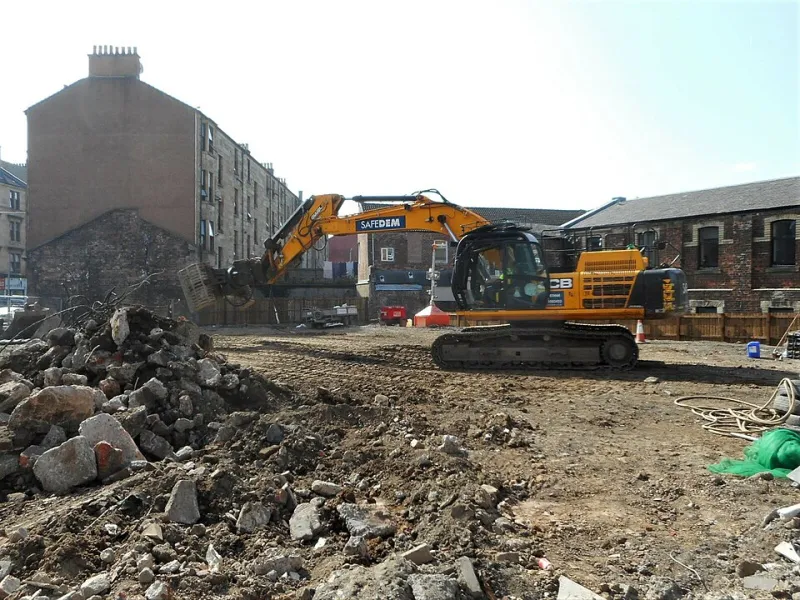
Photo: Richard Sutcliffe , CC BY-SA 2.0, via Wikimedia Commons
A developer buying a building to knock it down will usually spend considerable time on the demolition price, the programme and the planning position. Waste is often treated as a line item to be priced by the contractor and forgotten until the skips arrive. That is a mistake. Once the site is under the developer's control, the legal and financial risk associated with the materials leaving it becomes real, and it does not disappear simply because a demolition contractor has been appointed.
Duty of care begins before possession
The waste duty of care under section 34 of the Environmental Protection Act 1990 applies to anyone who produces, imports, carries, keeps, treats, disposes of or controls waste. A developer that acquires a site with the intention of clearing it is likely to be a waste producer or holder for these purposes. The duty includes taking reasonable steps to ensure that waste is managed properly, that it is transferred only to authorised persons, and that an adequate written description accompanies it.
This matters at acquisition because the buyer inherits more than a building. It inherits the previous use, the likelihood of contamination, the possibility of abandoned materials and the documentary gaps left by the seller. A pre-exchange review should therefore ask what waste streams the demolition will create, whether hazardous materials are suspected, who will act as consignor, and what evidence the contractor will provide. These questions are easier to answer before completion than after the first skip has left site.
What counts as waste when the building is still standing
Demolition waste is not limited to rubble. Soft strip, partitions, ceilings, glazing, cladding, mechanical and electrical equipment, oils, fuels, lead-containing paint, asbestos-containing materials and contaminated soils can all fall within the waste regime. Some materials become waste only when they are discarded, but demolition usually makes that intention clear. Classification should be based on the actual material and its hazardous properties, not on a generic label such as 'builders waste'.
The tender should require a waste schedule organised by stream, with forecast quantities, European Waste Catalogue codes, hazardous properties where relevant, proposed treatment or disposal routes and the assumptions behind those figures. The waste hierarchy should be visible in the proposal: what can be retained, reused or recycled, and what genuinely needs disposal. A contractor that cannot explain its classification assumptions is unlikely to produce a credible paper trail later.
The paper trail the tender should demand
A demolition tender that says only 'waste disposal included' gives the developer very little control. The proposal should identify the carriers, brokers and receiving facilities to be used, confirm that each holds the relevant permit or licence, and explain how transfer documentation will be issued. In England, carriers and brokers must hold a waste carrier, broker and dealer licence; in Scotland and Northern Ireland different registration regimes apply. The relevant regulator's public register should be checked rather than relying on a PDF certificate supplied by the contractor.
The receiving facility matters as much as the carrier. A transfer station authorised to store waste may not be permitted to treat it, and a landfill will have its own acceptance criteria. Developers should ask for the facility permit numbers and be satisfied that the proposed route is consistent with the waste classification. The tender should also state who will sign consignment notes, who will retain copies and how discrepancies will be reported.
Consignment notes and transfer notes are not interchangeable
For non-hazardous waste, a waste transfer note should accompany each transfer. It must describe the waste, how it is contained, the quantity, the European Waste Catalogue code and the parties involved. For hazardous waste in England and Wales, a hazardous waste consignment note is required, with additional details such as the hazardous properties, the consignor and consignee premises codes and the carrier's details. Scotland and Northern Ireland use different forms and terminology, but the principle is the same: hazardous waste needs a more detailed and controlled record.
These documents are not administrative decoration. They are evidence that the developer has met its duty of care. Waste transfer notes should be kept for at least two years and hazardous waste consignment notes for at least three years. If a regulator or a prospective purchaser asks what happened to a consignment of asbestos-containing material, a vague answer is not enough.
From site start to handover
At site start, the contractor should provide a waste management plan that matches the tender. It should set out segregation arrangements, storage areas, signage, responsibilities and the procedure for stopping work if an unexpected material is found. Toolbox talks should cover what operatives should do when they encounter suspect insulation, oils or contaminated soil. The developer should nominate someone to review transfer documentation as it is issued, not months after completion.
At handover, the developer should receive a waste reconciliation pack. This should compare forecast and actual tonnages, explain significant variances, confirm that all consignment notes have been closed and identify any exceptions. The pack should be linked to the planning conditions and any sustainability commitments attached to the scheme. A final payment milestone can sensibly be made conditional on that pack being complete and legible.
Commercial terms that make the trail enforceable
The most effective way to protect the developer is to write evidence into the contract. The tender should require sample waste transfer notes and consignment notes, a named waste champion, audit rights and a clear allocation of responsibility for classification. The contract should state who is the consignor, how hazardous waste will be handled and what happens if a carrier or facility is changed. Retention or final payment can be tied to the delivery of the reconciliation pack.
None of this removes the need for a competitive demolition price. It simply recognises that the cheapest skip is rarely the cheapest outcome. A developer buying to knock down should treat waste duty of care as part of due diligence, tender evaluation and handover, not as an afterthought once the site is clear. The paper trail is part of the asset, and it should be built before exchange.