Ground Rules Before Ground Movement: Procuring Vibration Control for Urban Demolition

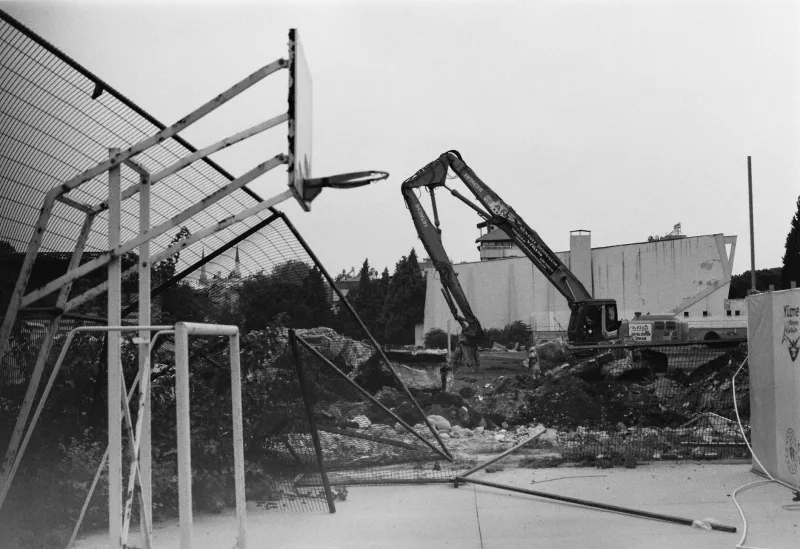
Photo: Alan Longbottom, CC BY-SA 2.0, via Wikimedia Commons
Introduction
Urban demolition in the UK rarely fails because a contractor cannot knock down a structure. It fails at the edges: the adjacent Victorian terrace, the party wall, the sensitive laboratory, the listed facade. Vibration is one of the few demolition effects that can be measured, predicted and controlled before the first panel is removed. Yet it is often left to a post-start monitoring regime, agreed when works are underway and positions have hardened.
For developers, the commercial risk is clear. A vague vibration requirement invites either an unpriced allowance or a low tender that ignores monitoring. Once works begin, exceedances can trigger neighbour complaints, party wall disputes, stop notices and programme delay. The better approach is to make vibration control a procurement control: define the performance requirement, require a monitoring method, secure baseline evidence and set escalation triggers before the demolition contract is awarded.
Why BS 7385 Is a Starting Point, Not a Specification
BS 7385 provides the established UK framework for evaluating vibration in buildings. It distinguishes between human response and cosmetic damage, and it recognises that frequency, duration and structure type matter. A single peak particle velocity figure copied into a tender is therefore rarely enough. The standard is a reference point, not a substitute for project-specific limits.
Developers should ask their demolition contractor and structural engineer to translate BS 7385 into a site-specific regime. That regime should identify the relevant receptors, the dominant vibration sources, the frequency bands of concern and the monitoring locations. It should also say whether limits are set for cosmetic damage, human comfort, or both. On sites close to residential property, human response can be the tighter constraint even where structural damage is unlikely.
The tender documents should state the required outcome and the evidence expected, rather than leaving the contractor to infer both. A performance requirement might specify that works must not cause cosmetic damage to identified neighbouring structures and must remain within agreed PPV limits at named monitoring points. The method statement should then explain how those limits will be achieved and verified.
Baseline Surveys: The Evidence Before the Evidence
A vibration limit without a baseline condition survey is a dispute waiting to happen. Neighbouring structures often contain pre-existing cracks, loose render, distorted window frames and historic movement. If those conditions are not recorded before demolition, any later crack can be attributed to the works.
The procurement pack should require a schedule of condition for sensitive neighbouring structures, agreed with the owners before works start. Party wall procedures may already require this where the Party Wall etc. Act 1996 applies, but the demolition specification should not assume that the party wall surveyor's scope covers every vibration receptor. Listed buildings, buildings at risk, structures with foundations close to the site boundary and premises containing sensitive equipment may need additional survey input.
The baseline should be more than a photographic record. It should identify existing defects, their location and severity, and the method used to record them. It should also establish access arrangements for post-works inspection. Where access is refused, the tender should require the contractor to record that refusal and propose an alternative means of protection, such as more conservative limits or additional monitoring.
Setting Trigger Levels That Can Be Used
A common weakness in demolition tenders is a monitoring requirement with no escalation logic. The contractor promises to monitor, but the contract does not say what happens when a reading approaches or exceeds a limit. The result is data without decisions.
A workable regime uses at least three levels. An alert level gives early warning that measured vibration is approaching the agreed limit and should prompt a review of method, plant or sequencing. An action level requires a documented response, such as changing demolition technique, increasing separation or adjusting the programme. A stop level requires works in the affected area to pause until the cause is understood and the developer, contractor and relevant neighbour are informed. These levels should be set with reference to the baseline survey and the structural assessment, not chosen arbitrarily.
The tender should require the monitoring plan to identify equipment, calibration arrangements, monitoring frequency, trigger notification times and reporting lines. It should also state who receives the data and how quickly. On tight urban sites, a daily report is seldom enough during peak activity. Real-time or near-real-time monitoring may be appropriate where the risk is high, but it must be supported by a response protocol rather than simply added to the cost plan.
Monitoring as a Tender Line, Not an Afterthought
Vibration monitoring is sometimes omitted from the priced tender and treated as a provisional sum or a later instruction. That approach weakens competition and obscures cost. Developers should require monitoring to be priced as a defined scope, with rates for additional monitors, extended duration and out-of-hours attendance. Tenderers should also explain how they will demonstrate independence and data integrity, particularly where the contractor is both performing the works and reporting on its own compliance.
Evaluation should test the proposed method, not just the price. A credible tender will show how monitoring locations were selected, how baseline data will be used, how exceedances will be managed and how neighbours will be kept informed. A low bid that treats monitoring as a paperwork exercise is not a like-for-like offer.
Conclusion
Vibration control is most effective when it is designed into the demolition procurement process. BS 7385 provides the technical anchor, but the commercial control comes from clear limits, agreed baseline surveys, defined trigger levels and a monitoring scope that is priced and evaluated. Developers who settle these points before award are better placed to protect neighbouring structures, maintain programme certainty and avoid the reactive disputes that follow an unexplained crack or a late-night complaint.