The Design Behind the Prop: Temporary Works Ownership on UK Demolition Sites
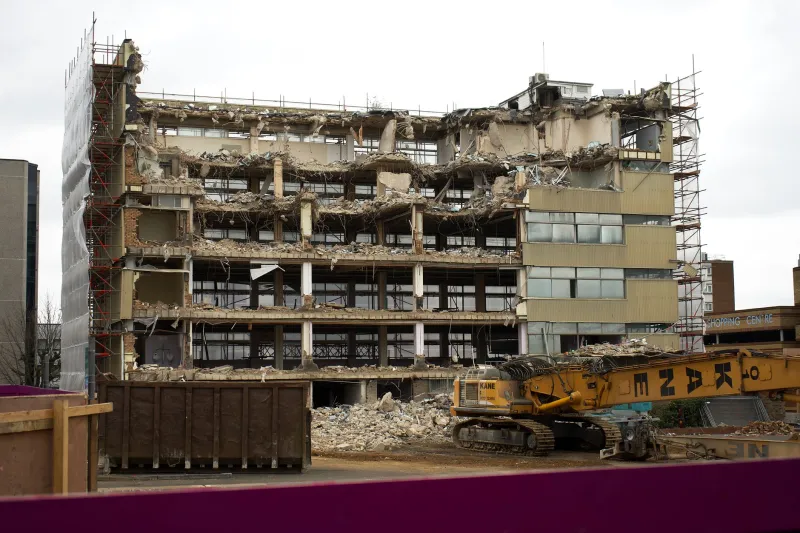
On a demolition project the permanent structure is leaving, yet for months it must continue to stand. The propping, needling, façade retention and basement support that maintain stability during that interval are temporary works, and they are often the least precisely defined elements in the whole package. The permanent works engineer has modelled the building as it was and as it will be; the demolition contractor has described a sequence in a method statement. Between those two documents sits a structural condition that may be nobody’s explicit design responsibility until something moves.
Where the gap opens
The gap is rarely the product of negligence. It emerges from the normal division of professional labour. A developer commissions structural information for the existing building and for the eventual replacement. A demolition contractor prices a method statement based on that information and on its own site experience. The temporary condition is then treated as a matter of construction sequencing rather than as a design problem in its own right.
Three patterns recur. First, the tender documents are silent on temporary works design, and each party assumes the other is carrying it. Second, temporary works are listed as a provisional sum or a contractor’s designed portion without a clear design brief, so the contractor prices a nominal allowance that bears little relation to the actual propping required. Third, the permanent works engineer provides a propping arrangement as a courtesy, but without the checking, load cases and movement criteria that a proper temporary works design demands. In each case the commercial risk is deferred rather than resolved.
What CDM 2015 expects
CDM 2015 does not create a stand-alone “temporary works designer” role, and it is a common error to search for one. Instead, the Regulations distribute duties across the existing parties. Designers must eliminate foreseeable risks so far as is reasonably practicable and provide information about residual risks. The principal contractor must plan, manage and monitor the construction phase, including temporary works, and must ensure that suitable arrangements exist for coordination between duty holders.
Industry good practice is set out in BS 5975, which remains the reference point for temporary works procedures. It describes the appointment of a temporary works coordinator, the preparation of a temporary works register, the issue of design briefs, and a checking regime proportionate to the category of the works. Those are not statutory requirements in themselves, but they are the benchmark against which an inspector, an insurer or a court is likely to assess whether the arrangements were suitable.
For a demolition project the practical consequence is that someone must own the temporary works process. On a larger scheme that is usually the principal contractor’s temporary works coordinator. Where the demolition contractor is not the principal contractor, the overall principal contractor still has to coordinate the interface. A developer who assumes the demolition contractor’s method statement automatically discharges that duty is likely to be disappointed.
The tender question: whose design is it?
The single most useful step a developer can take is to remove ambiguity at tender. The documents should state expressly whether temporary works are an employer’s design item, a contractor’s designed portion, or a hybrid with defined interfaces. If the intention is that the contractor designs the propping, the tender should say so, require a design brief, and ask for the name and competence of the proposed temporary works designer and checker.
A well-drafted tender return will include a temporary works register, a schedule of designs and checks, and a movement monitoring plan. It will identify the load paths assumed during each demolition stage and will show how those assumptions interface with the permanent works engineer’s model. It will also state who bears the cost of standby if monitoring triggers a pause.
Where those items are absent, the bid is not necessarily poor; it may simply be incomplete. The correct response is a tender clarification, not a post-award instruction. A contractor asked to design temporary works after award, against a lump-sum price prepared without that scope, will either absorb a cost it did not price or seek a variation. Neither outcome improves the project.
Checks before the first prop goes in
Before mobilisation the developer should see evidence of five things. The first is a temporary works register that covers every prop, restraint, needling beam and basement support, with a named designer and checker for each. The second is a design brief that states the loads, the sequence, the acceptable movement and the consequences of exceedance. The third is confirmation that the designer’s professional indemnity insurance extends to temporary works; not every policy does, and the point is worth verifying rather than assuming.
The fourth is an independent check proportionate to the category of the work. BS 5975 describes categories of checking, and a façade retention scheme on a busy urban street rarely sits at the lowest category. The fifth is a monitoring regime with a baseline survey taken before any load is altered. Movement thresholds should be agreed in advance, together with the action that follows a trigger: who inspects, who instructs, who pays for the pause and who authorises resumption.
When the structure moves
Movement during demolition is not automatically a failure. Old buildings redistribute load as elements are removed, and small deflections may be entirely within the design assumptions. The difficulty is that movement is also the point at which contractual positions harden. If the contractor designed the temporary works and the movement arises from an inaccurate permanent-works survey supplied by the employer, the risk may sit with the employer. If the movement arises from inadequate propping design, it sits with the contractor. If the cause is disputed, the project can stall while the parties argue.
The way to avoid that argument is to agree the causation process before work begins. The contract should identify the monitoring party, the review period for readings, the threshold for a design review, and the mechanism for instructing remedial temporary works. It should also address latent defects in the permanent structure, because a demolition contractor cannot be expected to design for a condition that no reasonable survey could have revealed.
A question of ownership, not paperwork
Temporary works on demolition projects are sometimes treated as a documentation exercise: a register, a certificate, a signature before the prop goes in. That view underestimates what is being managed. The temporary condition is a designed structure with its own load paths, failure modes and tolerances, and it deserves the same clarity of ownership as the permanent works it replaces.
For developers, the practical step is a pre-start temporary works workshop with the demolition contractor, the permanent works engineer and the principal contractor’s temporary works coordinator in the same room. The agenda should be the register, the interfaces, the monitoring plan and the variation mechanism. An hour spent on that agenda is usually cheaper than a week spent establishing, after a crack appears, who was supposed to have designed the prop.