Drawn, Settled, Discharged: Putting Dewatering Consents in the Demolition Tender
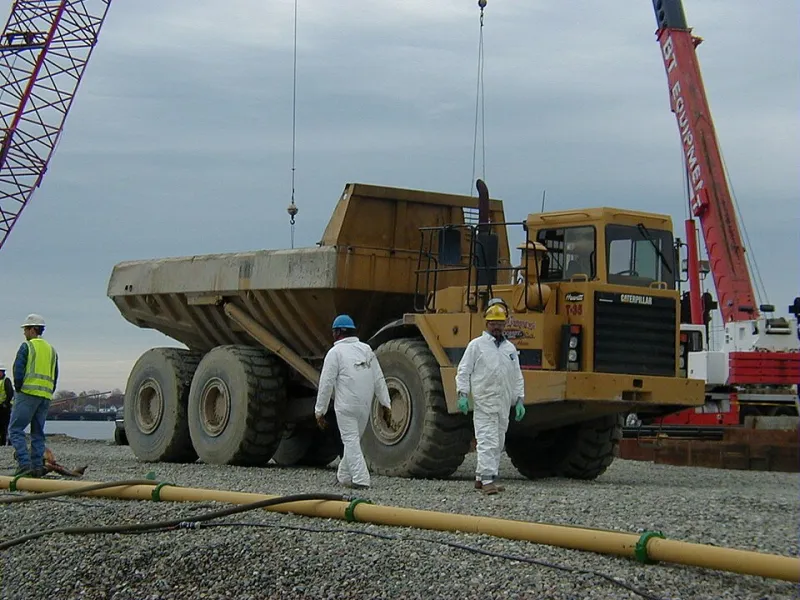
Photo: MassDEP Photographs, CC BY 2.0, via Wikimedia Commons
Groundwater is the quietest constraint on a demolition programme. It does not appear on a demolition drawing, it rarely features in a tender enquiry, and it is often reduced to a single line in a contractor's method statement: 'dewatering as required'. Yet on sites with basements, culverts, submerged slabs or a high water table, the need to draw water down before and during works can determine whether the programme holds.
The difficulty is not the pump. It is the consent to abstract, the route for the discharge, the quality of the water and the time it takes to secure each of those. Where those matters are left to the contractor after award, they tend to surface as a variation, a delay or a stop-work notice. The remedy is to make dewatering a defined, priced and evidenced scope line in the tender.
The consent stack behind a sump
There is no single 'dewatering consent'. The regulatory position depends on three questions: how much water is being taken, where it is being put and what is in it.
Abstraction. Taking groundwater from an excavation is an abstraction. The Environment Agency's usual threshold is 20 cubic metres a day; above that, a water abstraction licence is likely to be needed unless a specific exemption applies. Exemptions exist, but they are fact-specific and should not be assumed. A basement box of modest footprint can exceed the threshold over a 24-hour pump run, particularly where the surrounding strata are permeable.
Discharge to controlled waters. Returning water to a river, stream, ditch, lake or coastal water is a discharge to controlled waters. It normally requires an environmental permit under the Environmental Permitting (England and Wales) Regulations 2016, unless it can be brought within a standard rules permit or a registered exemption. The regulator will look at the receiving water, the volume, the rate and the quality of the discharge.
Discharge to sewer. Discharging to a public foul sewer requires a trade effluent consent from the sewerage undertaker under section 118 of the Water Industry Act 1991. Discharging to a surface water sewer is not a free alternative; the sewerage undertaker's permission is still required, and capacity or pollution concerns may lead to refusal.
Works in a watercourse. An outfall or a temporary crossing in an ordinary watercourse needs land drainage consent from the lead local flood authority or the internal drainage board. Works in, over or under a main river need the Environment Agency's flood defence consent.
Each route has a different regulator, a different application and a different lead time. A tender that does not identify the route cannot price the consent.
Abstraction is the long pole
Of the consents above, the abstraction licence is usually the longest to obtain and the easiest to overlook. The agency will want a pump test or a credible estimate of yield, a description of the aquifer, the proposed rate and volume, the duration, and an assessment of effects on nearby abstractions, springs and water-dependent habitats.
On a demolition site, the available data is often thin. Boreholes may exist from a previous site investigation, but standpipe readings can be years old, and permeability figures may be derived from empirical tables rather than testing. A contractor asked to 'allow for dewatering' will price on the same thin data. The result is either a cautious premium or an optimistic rate that returns as a claim.
The practical answer is a pre-tender groundwater screening: review the existing logs and monitoring, identify the likely abstraction rate, and ask the regulator for a written view on whether a licence is needed. That exchange takes weeks, not days, and belongs in the programme before the tender list is fixed.
Silt, pH and the quality question
Even clean-looking groundwater carries fines. Dewatering discharges are routinely conditioned on suspended solids, pH, temperature, oil and grease, and sometimes on specific contaminants identified in the ground investigation. The regulator may require settlement, filtration or pH correction before discharge, and may impose monitoring and record-keeping.
A sump and a pump do not constitute treatment. A discharge plan should identify the settlement volume, the treatment method, the sampling point and the person responsible for monitoring. On tight urban sites, settlement tanks and lagoons take space that the demolition sequence also needs. That is a layout question as much as an environmental one.
When contamination changes the route
If the groundwater is contaminated — by chlorinated solvents, hydrocarbons, heavy metals or other leachate — the discharge options narrow. Surface water discharge may be refused outright. A trade effluent consent may be available only with pretreatment and tight limits. In many cases the water must be tankered to a permitted waste treatment facility, at a cost per cubic metre that dwarfs the pumping cost.
The tender pack should therefore include the contamination status of the groundwater, not just the soil. That means a groundwater sampling suite agreed with the regulator or the water company, a volume estimate based on a pump test or a reasoned calculation, and a clear split between clean water (which may be discharged) and dirty water (which may not). Wheel washes, dust suppression and sump water should not be allowed to commingle by default.
What the tender pack should require
A demolition enquiry that expects a credible dewatering price should carry the following:
- A groundwater conceptual model, with strata, resting water levels, permeability, recharge and any tidal or river influence.
- All monitoring data, including standpipe readings and any pump test results, with dates.
- A defined discharge route, with written evidence of availability: sewer capacity confirmation, outfall consent, or a tankering arrangement.
- A named party responsible for each consent, and a consent programme with dates.
- A dewatering method statement covering drawdown, monitoring, treatment, discharge quality and contingency.
- A volumetric rate for pumping, treatment and tankering, with a provisional sum for contaminated water.
- A stop-work and notification protocol if discharge quality fails or a consent is varied.
- A reinstatement and post-works monitoring obligation.
Programming consent, not just pumping
Consents have determination periods. Abstraction licences are commonly quoted at up to 13 weeks, environmental permits can take longer where consultation is needed, trade effluent consents typically run to several weeks, and land drainage consents have their own timetable. These periods sit on the critical path if the works cannot proceed without them.
The tender programme should show the consent dates, the float and the consequence of late determination. A developer may choose to carry the consent risk centrally, or to make possession conditional on the consents being in place. Either is defensible; leaving it unallocated is not.
Dewatering is not a contractor detail to be discovered after the first excavation. It is a regulated activity with a consent stack, a discharge route and a quality regime. The tender is the point at which those facts are either established or deferred. Deferring them does not remove the risk; it moves it downstream, where it is more expensive.