Containing the Commotion: Neighbour Management on Tight Urban Demolition Sites
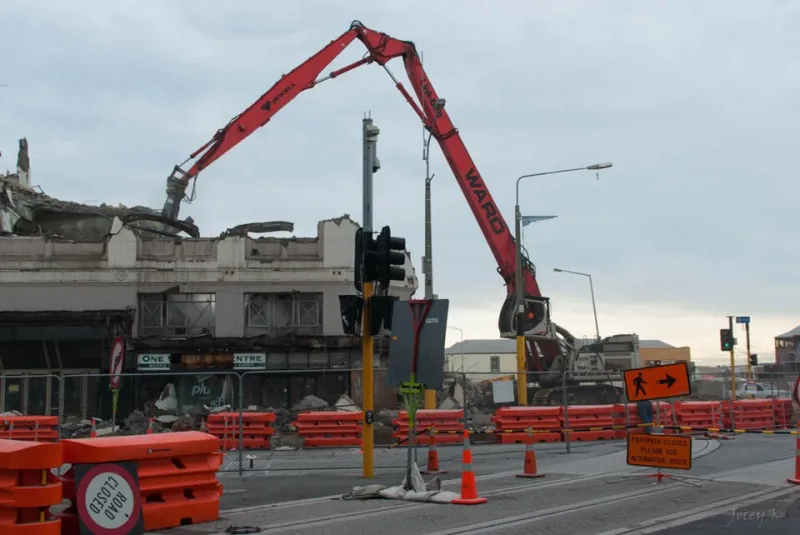
Photo: Jocelyn Kinghorn, CC BY-SA 2.0, via Wikimedia Commons
On a constrained urban site, the working day rarely ends quietly. A machine that has been stripping a rear extension since morning tends to be at its most audible at half past five, when the street fills up, windows open and the first resident of the evening reaches for the council's environmental health number. By six the calls have been logged; by the following morning the developer is answering an email that mentions statutory nuisance, and the programme has acquired a risk it never scheduled for.
Demolition in built-up areas is a consenting exercise as much as a physical one. The firms that manage it well treat the surrounding streets as part of the project scope, with the same rigour applied to method statements, monitoring and record-keeping as to the structural works themselves.
Section 61: consent, not immunity
Section 61 of the Control of Pollution Act 1974 allows a contractor to apply to the local authority for prior consent to carry out construction or demolition works, setting out the methods, plant and hours proposed. Consent buys a degree of certainty: works carried out in accordance with it are largely protected against later nuisance action. It is not a blanket licence. The authority can attach conditions, vary them, and — where works are already causing problems — serve a Section 60 notice imposing its own requirements.
Applications should be lodged early. Determination can take up to 28 days, and a submission returned for amendment costs the programme more than the consent exercise itself. The application is also the point at which the developer's intentions become auditable. Noise predictions referenced to BS 5228-1, a plant schedule with sound power levels, the position and height of acoustic screens, the sequence of noisy activities and the proposed hours all belong in that document, not in a later conversation with an irate neighbour.
Choosing working hours you can defend
Standard hours — 08:00 to 18:00 on weekdays, 08:00 to 13:00 on Saturdays, with nothing on Sundays or bank holidays — remain the default expectation across most authorities. A developer who wants a seven o'clock start or a full Saturday needs a specific justification and will usually be asked to demonstrate that the noisiest operations can be contained within the boundary.
The harder discipline is internal. The last hour of the day is where goodwill is most often lost: plant left idling, skips exchanged at the gate, arisings dropped into a container from height. A site manager who plans the closing hour as carefully as the opening one — engines off, loading complete by 17:00, gates closed and the highway swept — removes most of the raw material for complaint. Sequencing matters too. Concrete breaking, pile cropping and crushing are better placed mid-afternoon, when ambient street noise is at its highest and fewer residents are at home.
Dust: the complaint that travels furthest
Dust crosses the site boundary in a way that noise does not, and it leaves evidence on windowsills and washing. In London, the mayor's supplementary planning guidance on the control of dust and emissions during construction and demolition sets expectations that many authorities outside the capital now mirror: a dust risk assessment, defined mitigation for each risk category, wheel washing, sheeting of loads, water suppression on cutting and demolition, and monitoring where risk is elevated.
Real-time particulate monitors at the boundary, with alerts routed to a named person empowered to stop work, are inexpensive relative to the cost of a stop notice. The data also has a defensive use. When a complaint arrives about dust from a site where monitors show no exceedance and the log shows suppression running, the conversation is short.
Vibration and the buildings next door
On terraced streets and around Victorian stock, vibration is the concern that escalates fastest, because it is felt rather than heard and because the potential consequences — cracked plaster, dislodged tiles — are visible. BS 5228-2 addresses human response; BS 7385-2 sets out the thresholds at which cosmetic damage becomes possible. A method statement should show how the selected plant keeps peak particle velocity comfortably below those levels, with monitoring on the nearest sensitive receptors during high-energy operations.
Where the adjoining structure is listed or in poor repair, a condition survey before works begin is worth the fee. It converts a dispute about causation into a comparison of two sets of records.
A communication plan with a name in it
Notice letters are a minimum, not a plan. What residents actually use is a person: a named community liaison contact with a direct number, printed on the hoarding and in every letter, who answers during working hours and returns calls the same day. A weekly one-page look-ahead — plain language, setting out what will happen and when the noisy phases fall — is more useful than a single glossy newsletter at the start of the scheme.
Registration with the Considerate Constructors Scheme provides a useful external benchmark and signals intent to a planning authority that will be watching the site closely.
Complaints as programme data
Every complaint should be logged with time, location, activity and action taken, then reviewed weekly alongside progress. Patterns emerge quickly. Complaints tend to cluster around specific operations rather than specific people. A spike on Tuesday afternoons may be a screening position that has moved, not a neighbour with a grievance.
Building the neighbourhood into the programme
The developers who avoid the six o'clock phone call are rarely the ones with the quietest machines. They are the ones who assumed from the outset that the street was a stakeholder with a schedule of its own, and who priced the screens, the monitors, the surveys and the liaison time accordingly. On a tight urban site, that allowance is not a contingency. It is the cost of finishing on time.